 US
 China


Case Study: Custom Reed Relay Design Reduces Thermal EMF for Precision Test Instrumentation
Quick Look
- Customer: A well-known OEM of high-performance T&M solutions.
- Requirement: A compact reed relay with extremely low offset voltage for precision data acquisition equipment
- Challenge: Smaller relay packages can introduce higher thermal EMF due to their internal construction
- Solution: A customized version of the Series 118, designed to reduce thermally generated voltages in the signal path
- Result: Offset voltage reduced to approximately 3 µV, less than 10% of the standard catalogue part on which it was based
- Relay Type: A custom version of a Series 118.
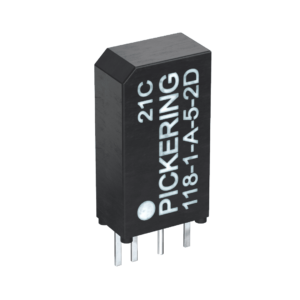
The Customer

The customer is a well-known OEM of high-performance test and measurement instruments. Its product portfolio includes precision data acquisition equipment used to measure low-level voltage and current signals, where even very small offsets can affect measurement accuracy.
Pickering reed relays were already used in the customer’s equipment, with Series 100 and Series 101 relays selected for their low thermal EMF performance. For a new product, however, the customer wanted a low offset voltage while also moving to a smaller relay footprint.
Many of the ATE systems include relay-based switching matrices to direct the paths of signals between a PCBA under test and signal sources and instrumentation. Understandably, in volume manufacturing scenarios it is crucial that the test equipment be fast, reliable and trustworthy.
The Requirement
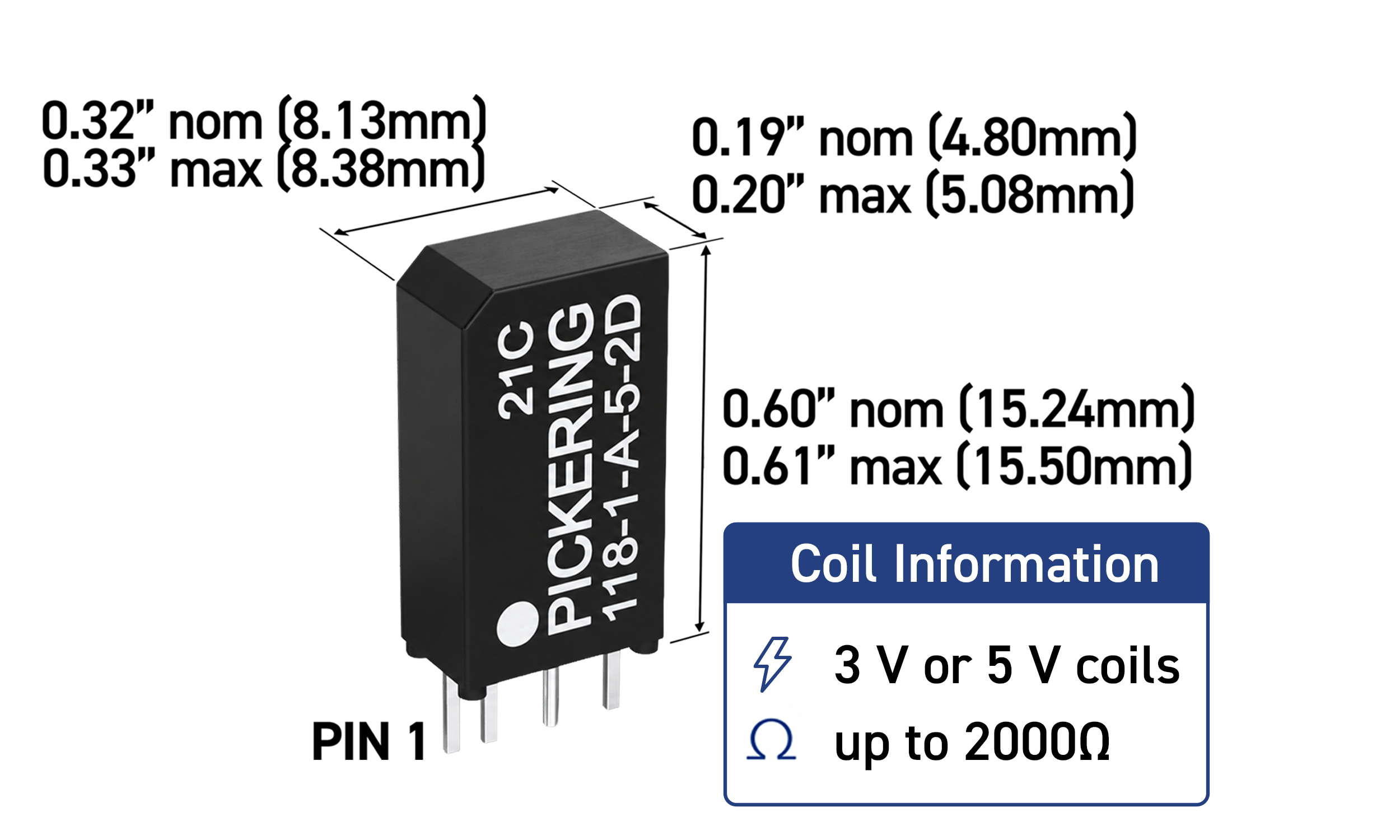
For the new design, the customer needed a reed relay that combined a compact footprint with the lowest practical thermal EMF. Their initial focus was on the Series 118, which offered a smaller vertical package and a high coil resistance compared with other compact options.
The customer correctly recognized that coil resistance can influence thermal EMF, because lower coil power can help reduce local heating. However, coil resistance is only one part of the issue. In precision applications, the internal signal path, relay construction and temperature gradients across conductive junctions can also contribute to offset voltage.
The customer evaluated several catalogue relay samples, but no standard part met the exact requirements. They therefore approached Pickering’s technical team to explore whether a customized solution could be developed.
The Challenge
Minimizing thermal EMF in a compact reed relay is a difficult design challenge.
Thermal EMF is largely caused by thermoelectric effects within the relay’s signal path. The most relevant of these are the Seebeck effect and, to a lesser extent, the Thomson effect. In simple terms, small voltages can be generated when conductive materials and temperature gradients are present in the same electrical path.
Technical Terminology for Reference
What is thermal EMF?
Thermal EMF is a small voltage generated when conductive materials and temperature differences are present in an electrical path. In precision measurement systems, this voltage can appear as an offset and affect the accuracy of low-level measurements.
Seebeck effect
The Seebeck effect is a thermoelectric effect where a temperature difference across conductive materials creates a voltage. It is the same principle used in thermocouples.
Thomson effect
The Thomson effect describes heating or cooling that can occur within a conductor when current flows through a temperature gradient
In a precision measurement circuit, these small voltages can appear as an offset. Although the voltage may only be measured in microvolts, it can still affect accuracy when measuring low-level signals.
In symmetrical reed relay designs, such as devices where the reed switch is mounted horizontally, thermally generated voltages can oppose and partially cancel each other. This helps keep the overall thermal EMF extremely low.
However, compact vertical relay packages are more challenging. Their internal construction is less symmetrical, and one side of the signal path may be closer to the coil or more exposed to local heating. This can create an imbalance in the thermally generated voltages, reducing the cancelling effect and increasing the overall offset.
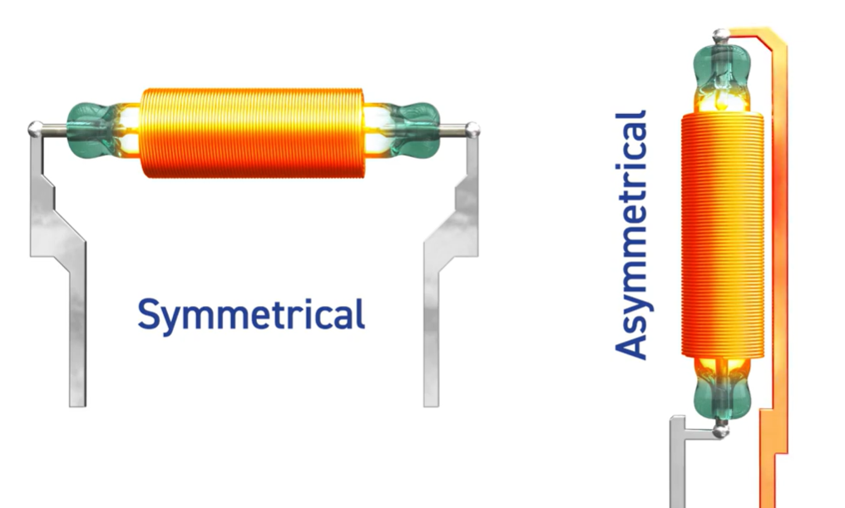
Figure 1. The asymmetrical construction of a relay with the switch vertical results in much higher voltages in one polarity than those in the opposite polarity, so the cancelling-out effect is not as effective as with a symmetrical device.
The Solution
Because the overall layout of the Series 118 could not be changed easily, Pickering focused on reducing the sources of thermal EMF within the relay’s internal signal path.
The standard construction was reviewed to identify where thermally generated voltages were being introduced. Pickering then developed and tested alternative internal connection methods designed to reduce thermal junction effects and improve the balance of the signal path, while retaining the compact Series 118 package.
An initial design change reduced the offset voltage from approximately 35 µV to around 20 µV. Although this was a useful improvement, the customer asked whether further reduction was possible.
Pickering then developed a more specialized construction method and advanced material selection that further reduced the thermally generated voltage across the signal path. This required a more complex manufacturing process, but it enabled a much lower offset while preserving the compact package required by the customer’s equipment design.
The Result
The final customized relay reduced offset voltage to approximately 3 µV. This was less than 10% of the offset voltage of the standard catalogue Series 118 on which it was based, and significantly lower than the intermediate customized version.
This allowed the customer to use a compact relay package while achieving the low thermal EMF performance required for precision data acquisition.
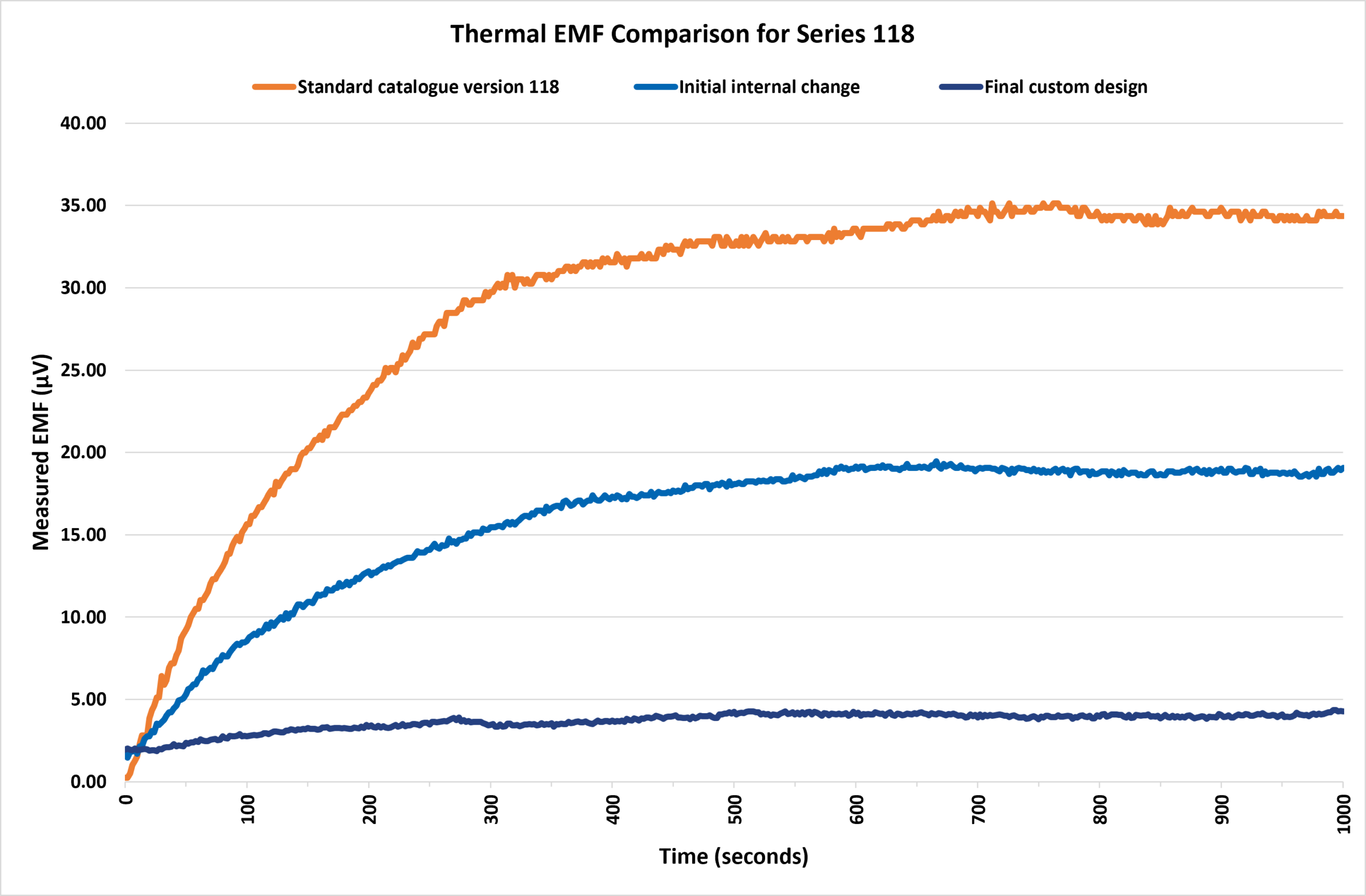
Figure 2. Thermal EMF comparison showing how offset voltage develops after the relay coil is energized. The final customized version reduced offset voltage to approximately 3 µV, compared with around 35 µV for the standard catalogue Series 118.
Although the customized construction resulted in a premium relay price, the customer gained important system-level benefits. The solution helped reduce equipment footprint, improved low-level measurement performance and avoided the need to redesign the instrument around a larger relay package.
The Relay Type & Conclusion
The final device was a custom version of the Pickering 118-1-A-5/1D.
The Series 118 was well suited to this project because its modular construction allowed Pickering to modify the internal signal path while retaining the compact package required by the customer. This enabled Pickering to respond quickly with a practical solution that addressed the customer’s measurement performance requirements without forcing a wider equipment redesign.
This project demonstrates how Pickering’s detailed understanding of reed relay design can help solve demanding precision measurement challenges.
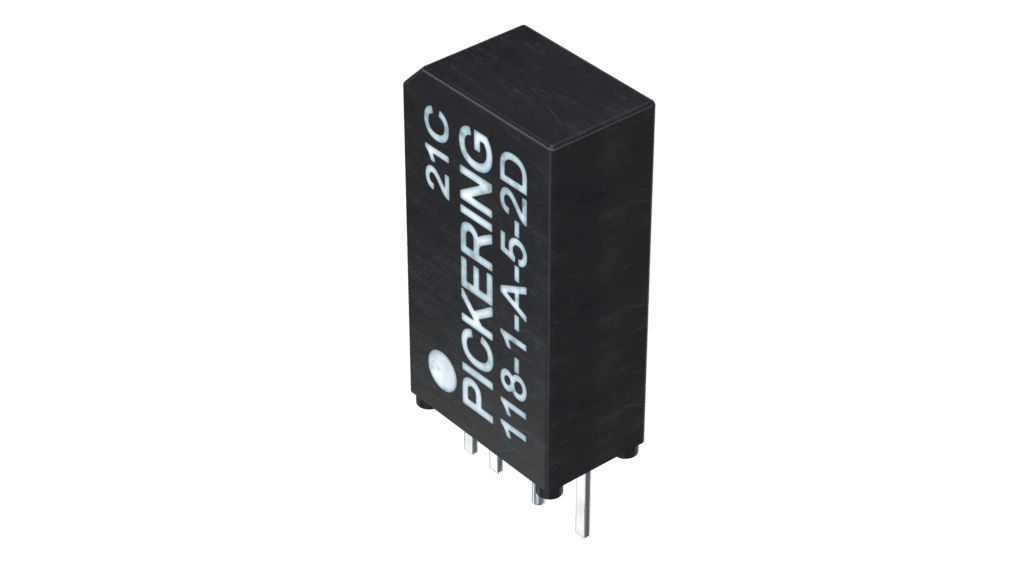
The customer needed a compact relay with much lower thermal EMF than available catalogue options could provide. By customising the internal signal path of a Series 118 relay, Pickering reduced offset voltage to approximately 3 µV while retaining the small footprint required for the customer’s data acquisition equipment.
The result was a compact, low-offset reed relay solution that improved measurement performance and helped the customer avoid a larger equipment redesign.

Facing a precision switching challenge? Our engineers can help you reduce thermal EMF, protect measurement accuracy and find the right reed relay solution. Our engineers can help you identify the cause and develop a reliable reed relay solution for your switching requirements.