 US
US
 China
China


Magnetic Interaction Explained 2026
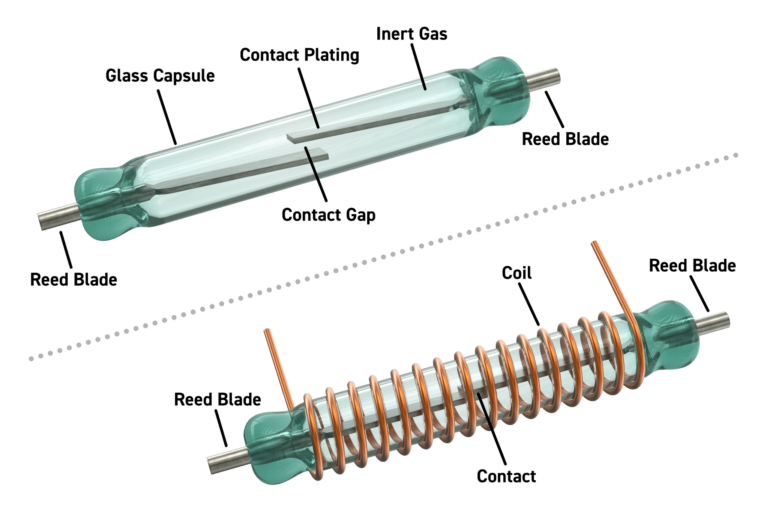
Reed relays are marvels of precision engineering. They operate by passing current through a coil, generating a magnetic field that is applied to a pair of ferromagnetic reeds enclosed within a hermetically sealed glass envelope. When the magnetic field is strong enough, it pulls the reeds together, closing the circuit. Once the magnetic field is removed, the reeds return to their original positions, breaking the circuit.
This simplicity and reliability make reed relays an ideal choice for applications requiring high-speed switching, compact design, and consistent performance. However, the reliance on magnetic fields also introduces a challenge: magnetic interaction.
What is Magnetic Interaction?
Magnetic interaction is a key consideration in the design and application of reed relays, particularly in high-density switching environments. When multiple relays are placed close together on a PCB, their magnetic fields can interfere with each other. This interference may result in delayed activation or even false switching, potentially compromising the performance and reliability of the entire system.
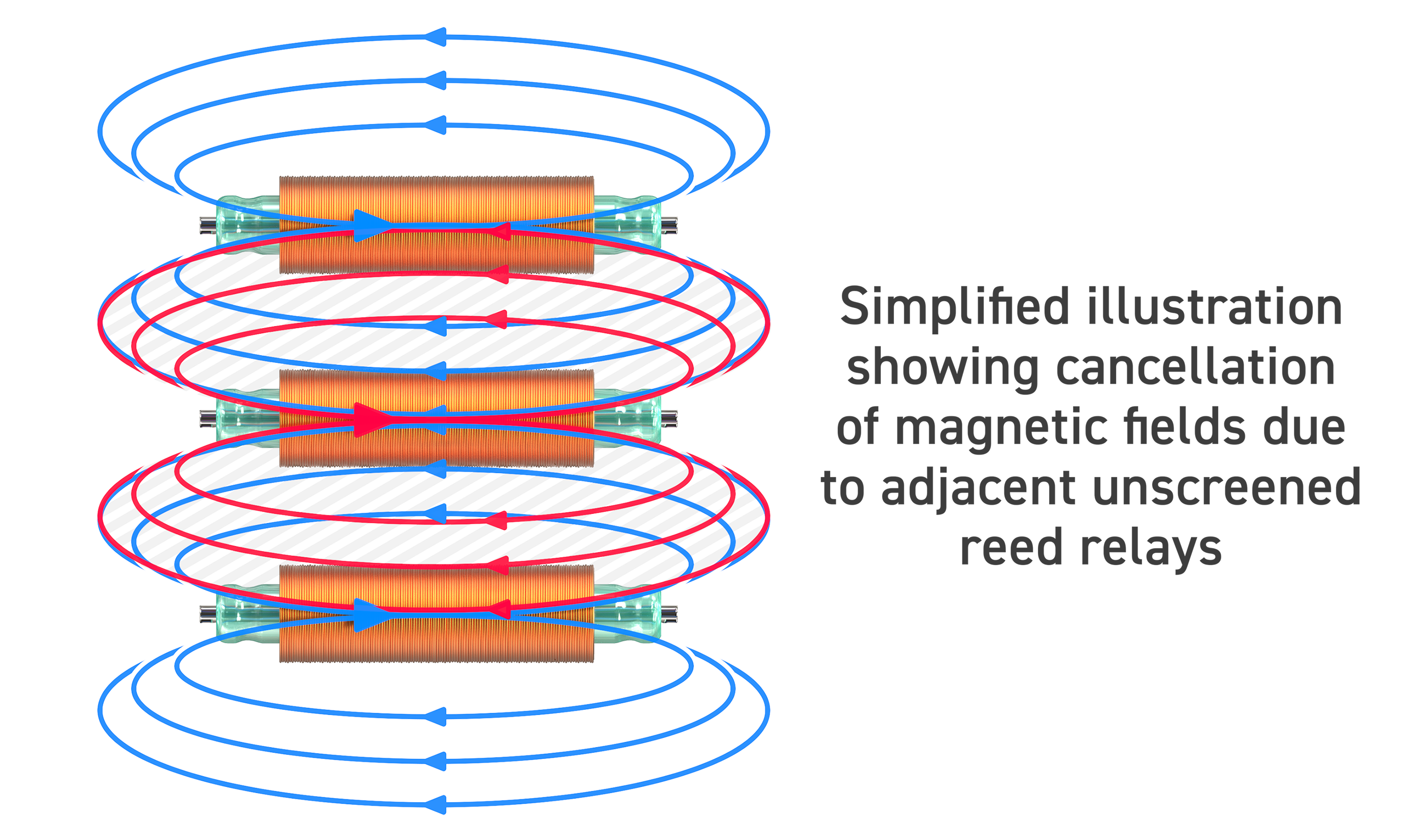
This simplified illustration shows the cancellation of magnetic fields due to adjacent unscreened reed relays. Reed relays with smaller or no magnetic screens can suffer from magnetic interaction when parts are stacked closely together. Unscreened relays can see operate voltage increases of up to 40% when stacked, compared to their operate voltage when used alone. Partially screened relays can see increases of up to 30%, whereas fully screened relays experience less than 5% increase.
Why Magnetic Interaction Matters
Reed relays operate using magnetic fields to close or open their reed switches. When multiple relays are tightly packed, the magnetic field of one relay can influence its neighbours, particularly if those relays have inadequate magnetic shielding. This interaction can lead to:
- Delayed Operating Speed: Adjacent magnetic fields may cause the relay to switch slower than expected, impacting system timing and precision.
- False Switching: A neighbouring relay’s field could unintentionally activate another relay, leading to circuit errors or potential damage.
- Reduced Reliability: Over time, constant interference can cause unstable contact resistance, causing the switch to degrade, effecting the performance and life expectancy. This is especially important in sensitive applications like test and measurement or semiconductor testing.
- Higher Operating Voltages: If the operate voltage exceeds the nominal supply voltage, relays may fail to operate when needed, leading to significant performance issues.
The Solution: Mu-Metal Magnetic Screening
To combat these challenges, Pickering employs mu-metal magnetic screening in its reed relay designs.
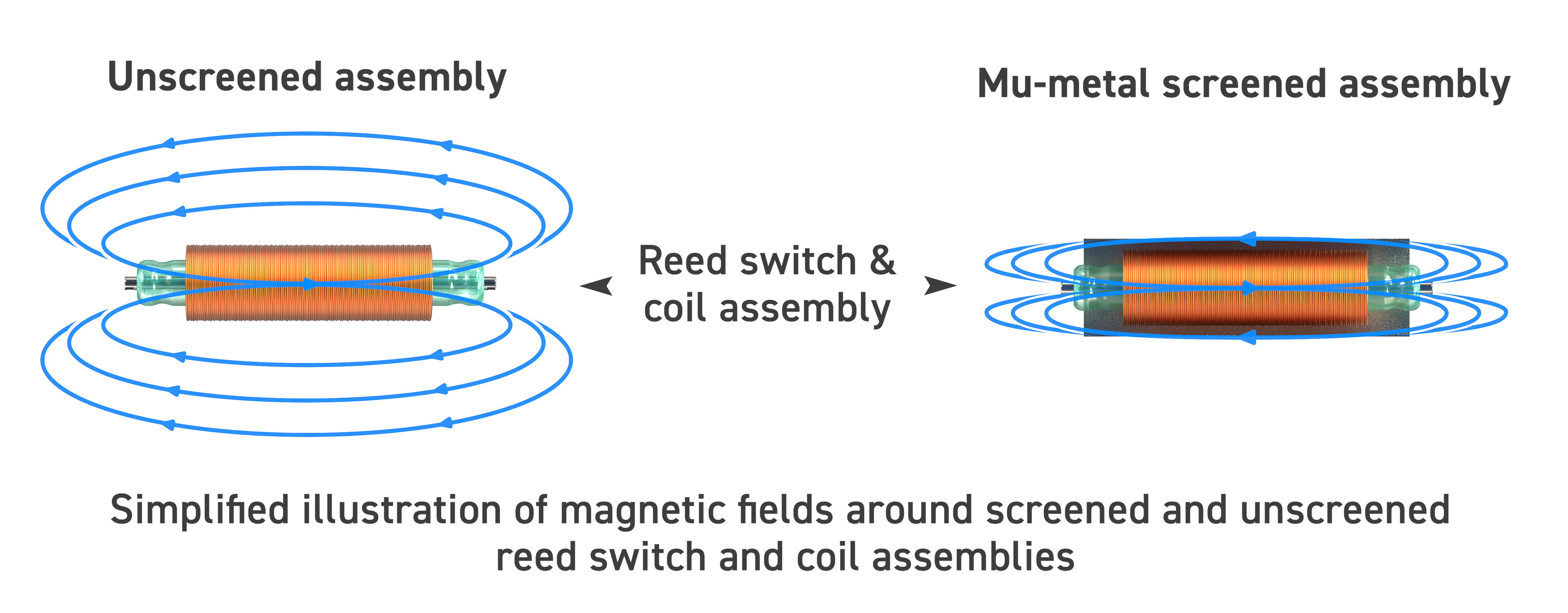
Magnetic screening enhances reed relay performance by aligning more of the magnetic field with the reed switch, increasing coil efficiency. For example, in an encapsulated reed relay with a mu-metal external case, the operate voltage was measured at 2.70VDC. Without the metal case, the operate voltage increased to 3.50V. Similarly, a relay with an internal U-shaped mu-metal screen had an operate voltage of 2.80V, which increased to 3.40V when the screen was removed.
This screening offers several advantages:
- Minimised Magnetic Crosstalk: By containing the magnetic field within the relay, mu-metal shielding prevents interference with adjacent relays.
- Precision Switching: With reduced external influence, relays maintain their specified activation and release times, ensuring consistent performance.
- Optimized PCB Layouts: Engineers can place relays closer together without risking magnetic interaction, enabling more compact and efficient designs.
- Enhanced Durability: By eliminating external magnetic influences, the relays experience less stress, extending their operational life.
Types of Magnetic Screening
There are two types of magnetic screening: external and internal. External screening typically involves a clip-on can for molded relays or the case for encapsulated relays. Internal screening involves fitting a formed piece of material to the coil in molded relays or inside the case in encapsulated relays.
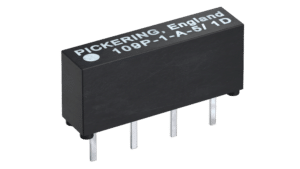
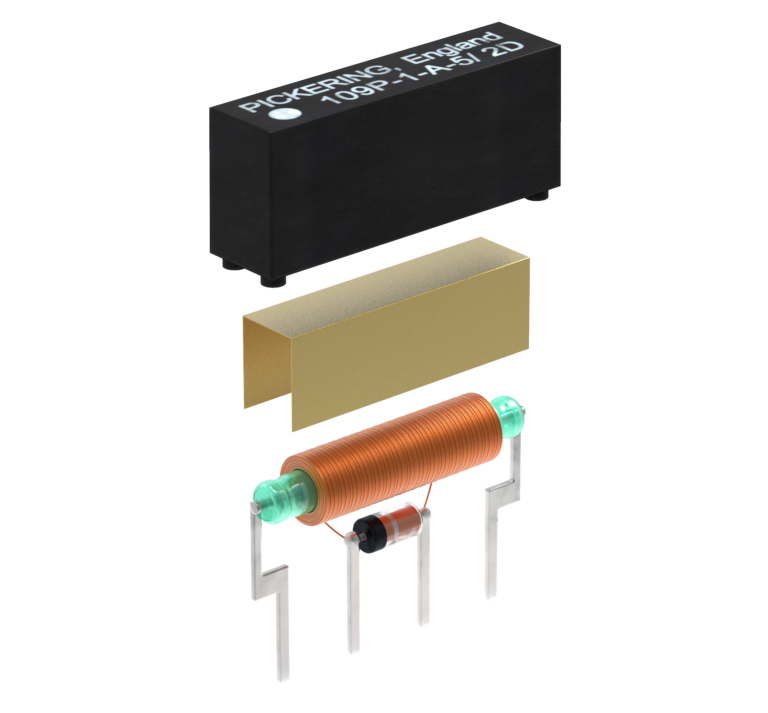
Different manufacturers use various materials for magnetic screening, such as steel, standard nickel iron, or the most efficient mu-metal. Mu-metal, which has a higher nickel content, offers superior shielding. Steel, on the other hand, can become magnetized over time (remanence), interfering with the magnetic field from the coil and altering switch operation characteristics. Standard nickel iron mitigates this issue but is less effective than mu-metal. Mu-metal’s higher permeability allows it to shield more magnetic field with a smaller screen, which is crucial for maintaining efficient screening in compact devices.
The size and placement of the magnetic screen significantly impact performance. A full-sized screen is easy to fit in an encapsulated relay but challenging in a molded part. Often, molded relays from some manufacturers use a smaller, curved piece of mu-metal, which provides some benefit but less than a full-sized screen. These relays might need more sensitive reed switches to operate at the required voltage, which can reduce performance.
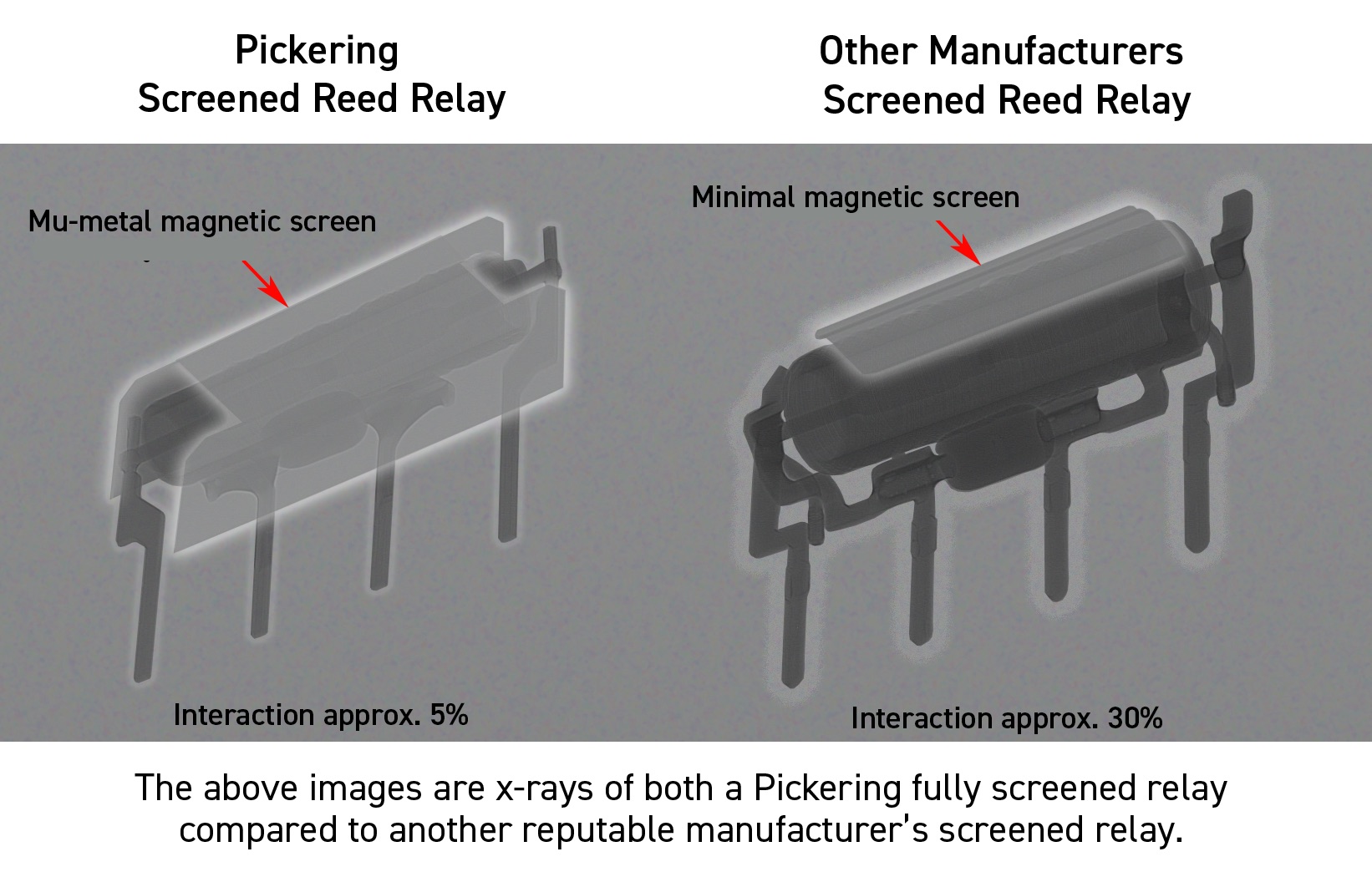
Low-cost manufacturers often use more sensitive reed switches to counteract the lack of magnetic screening, ensuring the operate voltage remains below the nominal supply voltage. However, using more sensitive reed switches can reduce overall performance. An alternative solution is to alternate the polarity of the coil in side-by-side configurations, but this adds complexity to the PCB layout.
Beyond Magnetic Shielding
Our expertise in reed relay manufacturing doesn’t stop at mu-metal shielding. Pickering continually innovates to provide even more robust solutions for high-density, high-performance applications:
- SoftCenter® Technology: This proprietary design ensures optimal alignment of the reed switch and magnetic components, further minimizing interaction risks.
- Compact, High-Density Relays: Models like the Series 125 and Series 131 showcase Pickering’s commitment to maximizing performance in the smallest footprints, all while maintaining impeccable shielding.
- Formerless Coil Technology: By removing the traditional coil bobbins, Pickering reduces the overall size of the relays and optimises the magnetic field, enhancing shielding effectiveness.
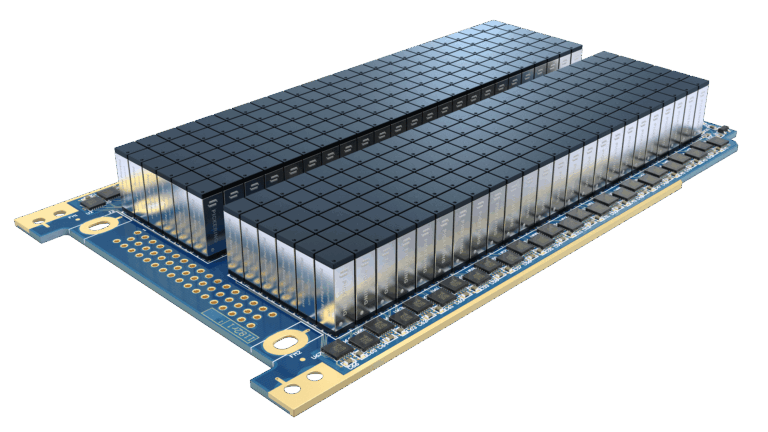
Pickering’s award wining Series 125 features a full mu-metal case, allowing hundreds of 2-pole relays to stack side-by-side with minimal magnetic interaction.
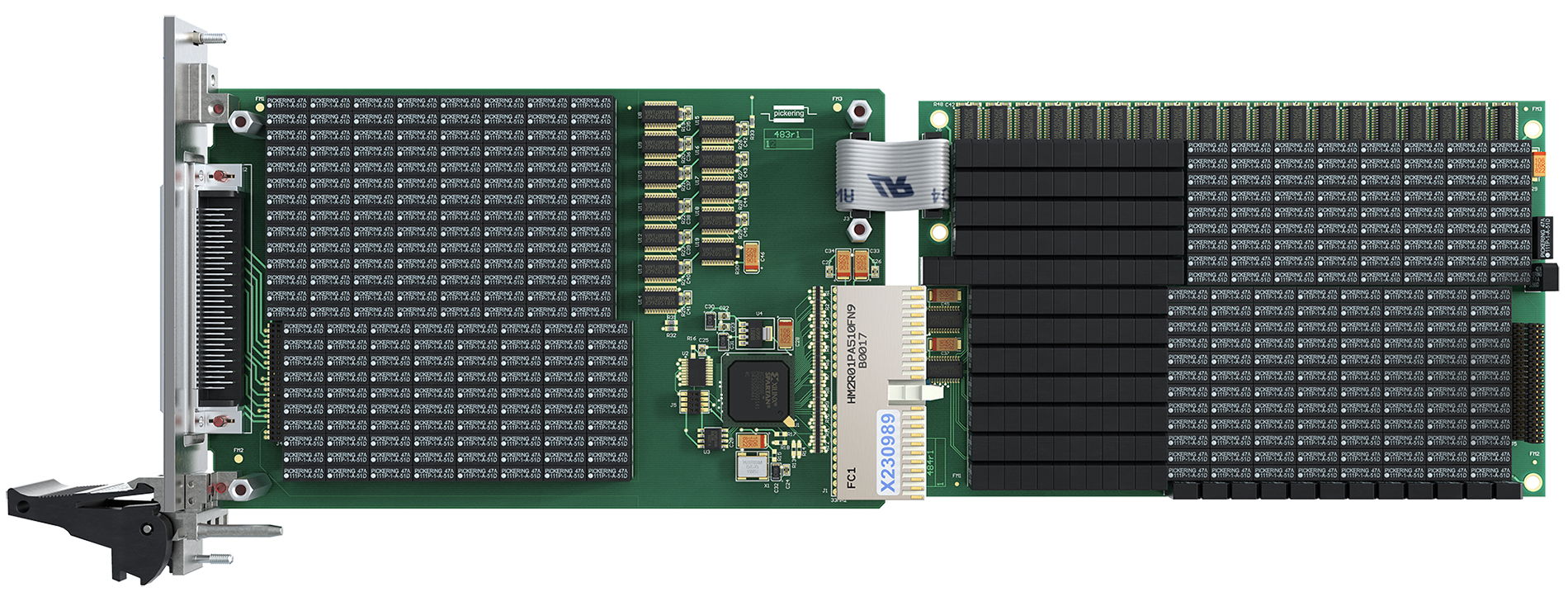
This module uses 360 Pickering Series 111P reed relays, plus 156 Pickering Series 117 reed relays.
A total of 516 reed relays!
Magnetic screening is absolutely essential for reed relays mounted on a close pitch to eliminate magnetic interaction issues.
Applications Where Magnetic Shielding is Critical
Magnetic interaction is especially critical in high density applications and applications requiring precision and reliability, such as:
- Semiconductor Testing: High-speed, high-density testing setups demand accurate switching without interference.
- Automatic Test Equipment (ATE): Ensuring consistent performance in tightly packed configurations is vital for test accuracy.
- Medical Devices: Magnetic shielding is essential in sensitive equipment to prevent interference that could affect patient safety.
- Automotive and EV Testing: High-voltage environments in electric vehicle systems require robust shielding to maintain system integrity.
Pickering’s History with Magnetic Shielding
Magnetic screening is essential for optimizing reed relay performance. It reduces magnetic interaction and enhances coil efficiency by focusing the magnetic field. For the best results, choose reed relays with effective magnetic screening, such as those using mu-metal. Pickering’s reed relays incorporate advanced magnetic screening to ensure reliable and efficient operation, making them ideal for demanding applications. Pickering’s screening is used across high-density and high-voltage reed relays for ATE, semiconductor test, hi-pot and insulation testing where predictable switching is critical.
Pickering has spent over 50 years perfecting its reed relay designs, ensuring each component meets the highest standards of performance and reliability. The inclusion of mu-metal magnetic screening is just one example of how Pickering anticipates and solves industry challenges, enabling engineers to design with confidence.
Talk to an Expert
Have a question? Need technical support? Our engineers are here to help.
Fill out the form below or email us – techsales@pickeringrelay.com

FAQs
Q: What does “magnetic interaction” mean in reed relays?
A: It’s when the magnetic field from one relay’s coil influences a neighbouring relay, changing how it operates when relays are packed closely together.
Q: What are the symptoms of magnetic interaction?
A: Higher operate voltage, slower or inconsistent switching, occasional false switching, and reduced repeatability in dense matrices.
Q: Is magnetic interaction the same thing as electrical crosstalk?
A: No. Crosstalk is usually capacitive/inductive coupling in conductors. Magnetic interaction is coil-field influence between relays.
When it matters most
Q: When should I worry about magnetic interaction?
A: When relays are stacked side-by-side on tight pitch, used in large matrices, or when timing/repeatability really matters (ATE, PXI/LXI, semiconductor test).
Q: Does contact form (1A, 2A, 1B, 1C) change interaction risk?
A: The main driver is coil field and physical proximity, but different packages and internal layouts can change how sensitive a design is when densely packed.
Q: Can magnetic interaction cause a relay to fail to operate?
A: Yes—if the effective operate voltage rises enough that your fixed supply can’t reliably drive the coil in a dense array.
High voltage / test relevance
Q: Why is magnetic interaction important in high-voltage test switching?
A: HV test matrices (hi-pot, insulation resistance, leakage) rely on predictable switching. Interaction can shift timing/operate points and introduce test variability.
Q: Does higher voltage switching increase magnetic interaction?
A: Not directly—the relay’s coil field causes interaction. But HV layouts often pack channels tightly while managing creepage/clearance, so predictable operation becomes more critical.
Q: Is magnetic screening related to high-voltage isolation (stand-off)?
A: They’re different. Isolation is about insulation distances/materials; screening is about containing coil magnetic fields. In dense HV matrices you often need both.
The solutions
Q: What’s the most effective way to reduce magnetic interaction?
A: Use relays with effective magnetic screening (ideally mu-metal), and follow layout practices that avoid putting coils too close without shielding.
Q: What’s the difference between internal and external magnetic screening?
A: External screening is a case/can around the relay; internal screening is a formed shield inside the relay near the coil/switch. Both reduce stray field, but effectiveness depends on size and placement.
Q: Why is mu-metal used instead of steel?
A: Mu-metal has very high magnetic permeability, so it’s better at guiding/containing the field. Steel can also suffer from remanence (becoming magnetised), which can alter behaviour over time.
Q: Can alternating coil polarity on a PCB solve interaction?
A: It can reduce field coupling in some arrangements, but it complicates routing and doesn’t replace proper screening in high-density designs.
Practical selection & design
Q: How can I tell if a relay is fully screened?
A: Look for a full metal case/screen specification (often mu-metal), and ideally stacked-pitch/interaction data from the manufacturer.
Q: What test data should I ask for to quantify magnetic interaction?
A: Operate voltage shift when stacked, release/operate timing changes, and interaction percentage (or equivalent) versus spacing and orientation.
Q: Does board orientation or relay rotation matter?
A: Yes—relative coil orientation and spacing can change how fields couple. In dense matrices, consistent orientation and screened packages help.
Reliability & consistency
Q: Does magnetic interaction affect long-term reliability?
A: It can—if relays operate closer to thresholds or switch inconsistently, it increases stress and can reduce stability over long life in automated test.
Q: Is magnetic interaction the reason some relays need “more sensitive” reeds?
A: Sometimes. If screening is limited, manufacturers may use more sensitive reeds to meet operate voltage targets—though that can come with performance trade-offs.