 US
US
 China
China


Relay Selection: Why Total Cost Matters More Than Purchase Price
In automated test systems, reed relays are often selected for practical reasons: footprint, contact form, coil voltage, switching capability and purchase price.
These are all important, especially when a switching matrix contains hundreds or even thousands of channels. But the true cost of a relay is not always shown in the unit price.
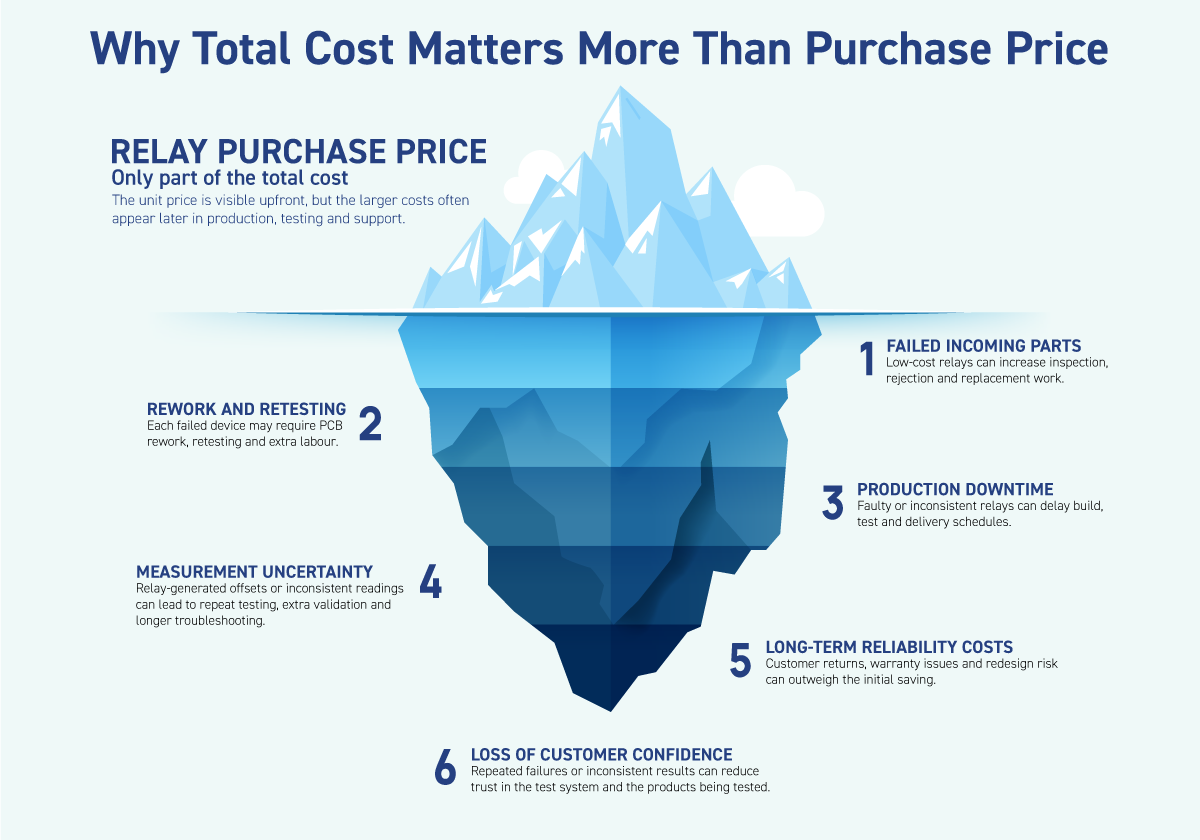
A low-cost relay may look suitable on paper, but if it leads to failed incoming parts, rework, unstable measurements, additional engineering time or reduced confidence in test results, the cost can quickly move beyond the component itself.
The following real-world examples show how relay selection can affect total cost of ownership, and how an initially cheaper relay can end up costing more once production, testing and long-term reliability are considered.
For engineers designing automated test equipment, semiconductor test systems, precision data acquisition equipment or high-density switching matrices, total cost of ownership should be part of the relay selection process from the beginning.
What total cost of ownership includes
A low-cost relay can become expensive when it leads to:
- production downtime
- failed incoming parts
- rework and replacement labour
- unstable measurements
- system redesigns
- customer returns or warranty issues
- loss of confidence in test results
This is why relay selection should not be based on purchase price alone. A relay that costs less initially can create additional costs elsewhere in the system, especially where reliability, repeatability and measurement accuracy are critical.
Pickering helps reduce total cost of ownership through instrumentation-grade reed switches, 100% testing, stable contact resistance, high insulation resistance, low leakage, magnetic screening, SoftCenter™ construction and custom engineering support where a standard relay is not enough.
When low purchase cost becomes a false economy
In one ATE application, an OEM had designed low-cost 0.2″ pitch SIL reed relays into a switching matrix. Although the published specification appeared suitable on paper, the customer soon experienced problems in production and operation.
The issues included failed devices on receipt, intermittent operation, inconsistent operate and release times, and variable contact resistance. Around 5% of the devices received from the original supplier did not work at all.
At that point, the problem was no longer just the cost of replacing faulty parts. Intermittent operation and variable contact resistance also made it harder to trust the switching path, adding investigation time before production could continue.
Switching matrix size | 5% incoming failure rate could mean |
|---|---|
100 relays | 5 faulty devices |
500 relays | 25 faulty devices |
1,000 relays | 50 faulty devices |
2,000 relays | 100 faulty devices |
In a matrix containing hundreds or even thousands of relays, that failure rate can quickly become more expensive than the saving made on the component price. For example, if a matrix uses 1,000 relays, a 5% incoming failure rate could mean around 50 faulty devices before the system is even in service. Each failed relay may require inspection, replacement, PCB rework, retesting and production delay.
Pickering evaluated samples of the original low-cost relays and found several design and performance concerns, including reed switches not suited to high-reliability instrumentation use, wide sensitivity variation, high contact resistance and no magnetic shielding. The level of inconsistency also suggested that only sample or batch testing had been carried out, rather than every relay being individually tested. By contrast, Pickering carries out 100% testing on every completed relay, helping to confirm consistent operation before the relay reaches the customer.
The customer needed a high-reliability replacement that could be used without redesigning the existing switching matrix PCB. Pickering recommended a size- and pin-compatible 106 reed relay, which included an instrumentation-grade reed switch, internal magnetic screening and a more controlled construction.
This solved the reliability issues and gave the customer a more consistent switching solution. The customer later asked whether the operating time could also be reduced, without increasing current draw across the switching matrix.
Pickering customized the relay using a more sensitive instrumentation-grade reed switch while keeping the coil unchanged. This reduced typical operate time from 0.195 ms to 0.152 ms, while meeting a tighter tested requirement of less than 0.3 ms.
Cost avoided
A pin-compatible Pickering replacement helped the customer avoid PCB redesign while reducing the risk of incoming failures, rework, retesting and inconsistent matrix performance.
Example cost comparison
A lower unit price can look attractive at the selection stage, but the overall cost changes when failure-related costs are included. This example shows how downtime, rework and testing failures can turn a lower-cost relay into the more expensive option over the life of the system.
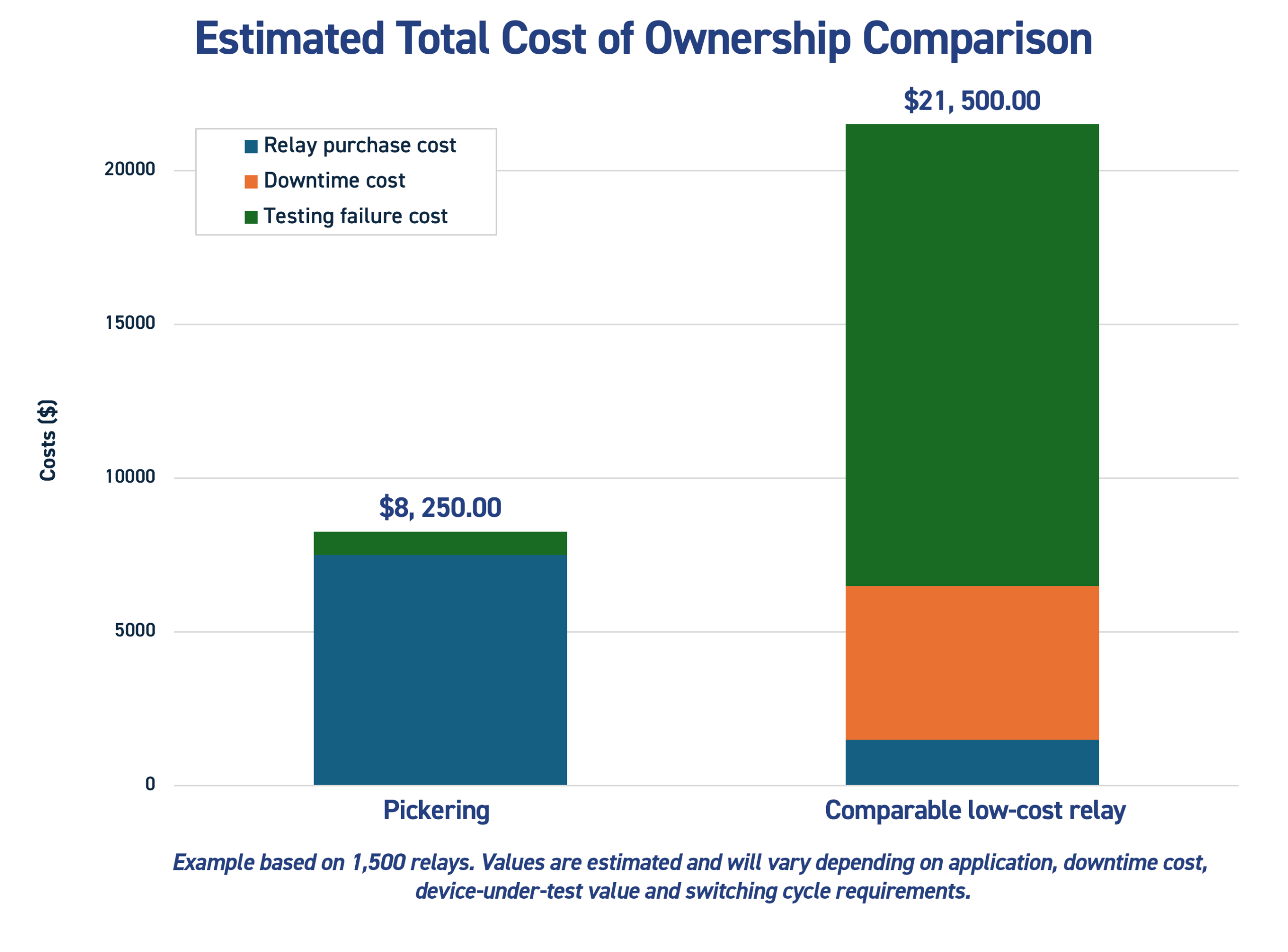
In this illustrative example, based on average costs, the alternative relay has a lower purchase cost, but estimated downtime and testing failure costs increase total cost of ownership to $21,500, compared with $8,250 for the Pickering relay.
Performance differences are not always visible from the footprint
Cost of ownership is not only affected by obvious failures. For example, two compact reed relays may look similar on paper, but behave very differently once they are part of a measurement path.
Pickering recently compared its Series 120 reed relay with a comparable high-density relay from another manufacturer. Both were compact relay solutions intended for dense layouts, but the test focused on thermal EMF: a small voltage generated when temperature differences occur between dissimilar conductive materials in a circuit.
Hidden cost factor | How lower thermal EMF can help |
|---|---|
Compensation time | Reduces the need to correct for relay-generated offset |
Retesting | Helps avoid repeat tests caused by measurement uncertainty |
Troubleshooting | Makes it easier to identify real DUT issues |
Validation effort | Supports more repeatable measurement paths |
Measurement confidence | Helps protect low-level signal accuracy |
In many applications, this voltage may be too small to matter. In low-level measurement systems, however, microvolt-level offsets can become a meaningful source of error.
If the relay introduces unwanted offset into the measurement path, engineers may need to spend additional time validating results, applying compensation, repeating tests or investigating readings that do not come from the device under test.
Relay-generated offsets can also make it harder to know whether a reading is caused by the DUT or by the switching component in the circuit.
Under the same controlled test conditions, the comparison relay moved from an initial average of approximately +2.45 µV to a final average of approximately -402.6 µV. The Pickering Series 120 moved from approximately -0.38 µV to -46.4 µV.
This means the comparison relay produced around 8.7 times more final thermal EMF offset than the Pickering Series 120 in this test. Put another way, the Series 120 showed around 88% lower final offset under the same controlled test conditions.
Cost avoided
Lower thermal EMF helped reduce measurement offset, correction time and calibration burden, protecting confidence in low-level test results.
When relay life affects maintenance and field cost
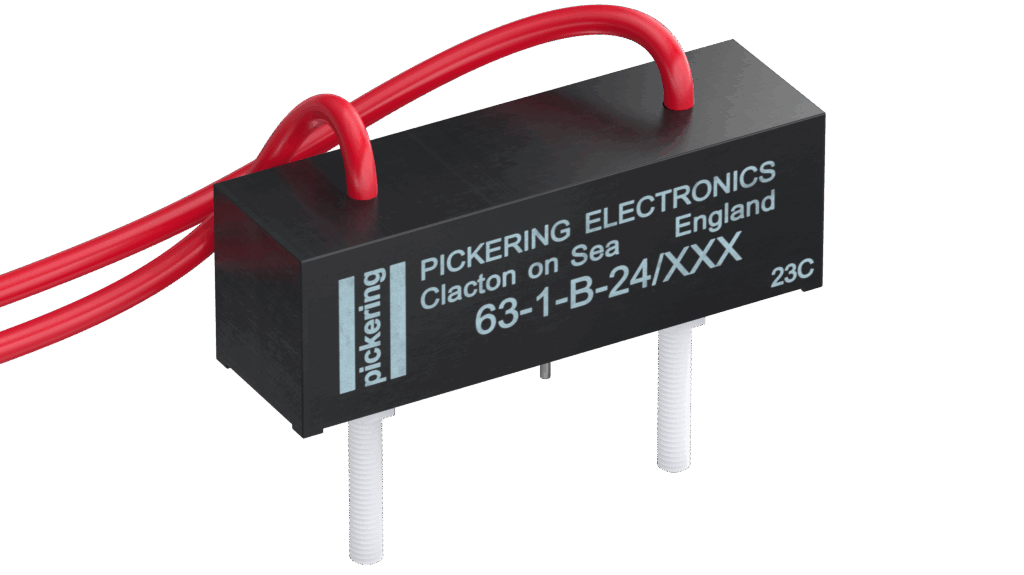
Custom Series 63 reed relay for a 6 kVdc discharge application.
Cost of ownership can also be affected by how reliably a relay performs once the equipment is already in use. In some applications, the cost of a relay issue is not limited to the component itself. It can include service time, replacement parts, equipment downtime and reduced confidence in the supplier.
In one high-voltage discharge application, a test and measurement OEM needed a relay solution capable of discharging 6 kVdc while achieving at least 20,000 operations. The challenge was not simply selecting a relay with a suitable voltage rating. High in-rush current during discharge could increase switch wear and shorten operating life.
Pickering worked with the customer to optimise the relay and discharge circuit, reducing peak power while keeping the discharge time within the required range. HALT testing later demonstrated more than 250,000 operations with minimal switch wear, well above the customer’s original operating life requirement.
Cost avoided
The customer reduced long-term maintenance and replacement risk by using a relay solution proven beyond the required operating life, helping protect equipment uptime and confidence in the supplier.
What engineers should consider
When evaluating reed relays for test and measurement systems, the lowest-cost option may not deliver the lowest overall cost.
Important factors include:
- Contact resistance stability
- Insulation resistance
- Leakage current
- Thermal EMF
- Magnetic shielding
- Operate and release time consistency
- Expected operating life
- 100% testing and quality control
- Pin compatibility and redesign risk
- The cost of downtime, rework or field failures
These costs do not always appear during incoming inspection or initial validation. In some cases, relay-related issues may only become visible once equipment is installed, shipped or operating in the field. At that stage, the cost can include customer support time, replacement parts, service visits, warranty claims and reduced confidence in the equipment supplier.
A relay that costs less initially can become more expensive over time if it leads to production downtime, customer returns, uncertainty in switching or measurement results, or additional replacement and support costs.
By contrast, a relay designed for stable, repeatable performance can help reduce long-term system costs by improving reliability and protecting measurement confidence.
Lower total cost starts with the right relay
In test and measurement applications, the real cost of a reed relay is not just what appears on the bill of materials. It is also the cost of what happens after the relay is built into the system.
A reliable relay can help reduce failures, avoid redesigns, improve test consistency and support long-term system performance. A poorly matched relay can create hidden costs through rework, downtime, unstable measurements and reduced confidence in the switching path or measurement results.
Whether the challenge is replacing unreliable low-cost parts in an ATE switching matrix or selecting compact relays for low-level measurement systems, the message is the same: similar size does not always mean similar performance, and low purchase price does not always mean low total cost.
Choosing a relay only by unit price can move cost into production, support and long-term reliability.
Speak to Pickering early in your design process to select a relay that fits the electrical, mechanical and commercial needs of the system.
